The heating, ventilation, and air conditioning (HVAC) industry has experienced significant growth over the past decade. As residential, commercial, and industrial buildings increasingly depend on climate control systems, the demand for reliable HVAC services continues to rise. However, managing installations, maintenance, emergency repairs, and customer service efficiently can be challenging for HVAC businesses.
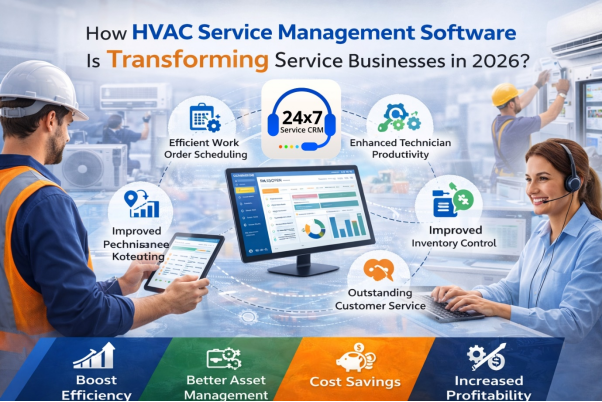
In 2026, technology is playing a crucial role in transforming how HVAC companies operate. One of the most impactful innovations in the industry is HVAC service management software. With the help of modern HVAC service software Service CRM, businesses can streamline operations, improve technician productivity, enhance customer satisfaction, and reduce operational costs.
HVAC companies that adopt digital service management tools are gaining a competitive advantage by delivering faster, more efficient, and more reliable services.
Understanding HVAC Service Management Software
HVAC service management software is a digital platform designed specifically to manage the operations of HVAC service businesses. It helps companies organize service requests, schedule technicians, track maintenance tasks, manage customer information, and generate invoices.
Traditionally, many HVAC companies relied on manual methods such as paper work orders, spreadsheets, and phone calls to manage their daily operations. While these methods may work for small teams, they become inefficient as businesses grow.
Modern HVAC service software replaces these outdated processes with automated systems that provide real-time visibility into service operations. This allows businesses to manage their workforce more effectively and provide better service to customers.
Streamlining Service Scheduling and Dispatching
One of the biggest operational challenges for HVAC companies is scheduling service appointments and dispatching technicians efficiently. Without proper scheduling tools, technicians may face overlapping appointments, long travel times, or inefficient routes.
HVAC service management software simplifies scheduling by automatically assigning service requests to the most suitable technicians based on availability, location, and expertise.
Dispatch managers can monitor technician schedules in real time and make adjustments when necessary. This ensures that service calls are completed on time and technicians spend less time traveling between jobs.
Efficient scheduling not only improves productivity but also helps businesses respond faster to emergency service requests.
Improving Technician Productivity
Field technicians are the backbone of HVAC service businesses. Their efficiency directly impacts service quality and customer satisfaction.
With modern AC service software, technicians can access all necessary job information through mobile applications. This includes service history, equipment details, customer information, and maintenance instructions.
Technicians can update job status, record service notes, upload photos, and generate digital service reports directly from their mobile devices. This eliminates paperwork and reduces administrative tasks.
As a result, technicians can complete jobs more quickly and focus on delivering high-quality service.
Enhancing Customer Experience
Customer expectations have evolved significantly in recent years. Today’s customers expect quick responses, transparent communication, and convenient service scheduling.
HVAC service management software improves customer experience by enabling businesses to provide automated appointment confirmations, service reminders, and technician arrival notifications.
Customers can stay informed about the status of their service requests, which increases trust and satisfaction. Some advanced systems also allow customers to schedule service appointments online, making the process more convenient.
By improving communication and service reliability, HVAC companies can build stronger relationships with their customers.
Efficient Work Order Management
Managing work orders manually can be time-consuming and prone to errors. Important details may be lost, and tracking job progress becomes difficult.
HVAC service software digitizes work order management by allowing businesses to create, assign, and track work orders through a centralized system.
Each work order contains detailed information about the service request, equipment involved, technician assignment, and job status. Managers can monitor progress in real time and ensure that all tasks are completed efficiently.
This streamlined process reduces administrative work and improves overall service coordination.
Automated Invoicing and Payment Processing
Handling invoices and payments manually can slow down business operations and create accounting challenges.
Modern AC service management software integrates billing and payment features that automate the invoicing process. Once a job is completed, technicians can generate invoices directly through the system.
Customers can receive digital invoices and make payments online, which speeds up the payment cycle and improves cash flow for HVAC businesses.
Automation also reduces billing errors and ensures accurate financial records.
Data-Driven Business Insights
One of the most powerful features of HVAC service software is its ability to provide detailed analytics and reporting.
Businesses can analyze key performance metrics such as technician productivity, service completion rates, customer satisfaction, and revenue trends.
These insights help HVAC companies identify operational inefficiencies and improve decision-making. For example, managers can determine which services generate the most revenue or which technicians complete jobs most efficiently.
Data-driven insights enable businesses to optimize operations and plan future growth strategies.
Preventive Maintenance and Service Contracts
Preventive maintenance is an important part of HVAC services. Regular maintenance ensures that heating and cooling systems operate efficiently and reduces the likelihood of costly breakdowns.
HVAC service management software allows companies to manage preventive maintenance schedules and service contracts effectively.
The system can automatically remind technicians and customers when maintenance is due. This ensures that HVAC systems receive regular inspections and servicing.
Preventive maintenance programs also create recurring revenue opportunities for HVAC businesses while improving system reliability for customers.
Reducing Operational Costs
Operational costs such as fuel expenses, overtime wages, and administrative overhead can significantly impact the profitability of HVAC service businesses.
HVAC service software helps reduce these costs by optimizing technician routes, automating administrative tasks, and improving resource allocation.
Route optimization reduces travel time and fuel consumption, while automated scheduling minimizes technician downtime. Digital documentation also eliminates the need for paper records and manual data entry.
By improving operational efficiency, HVAC businesses can increase profitability while maintaining high service quality.
Scalability for Growing HVAC Companies
As HVAC companies expand, managing service operations becomes more complex. Businesses may need to coordinate larger teams, handle more service requests, and manage multiple service locations.
HVAC service management software provides scalable solutions that grow with the business. Cloud-based platforms allow companies to manage operations from anywhere and access real-time data across multiple locations.
This scalability ensures that businesses can maintain efficient operations even as they grow.
Integration with Modern Technologies
In 2026, HVAC service management systems are increasingly integrating with advanced technologies such as Artificial Intelligence (AI), Internet of Things (IoT), and predictive analytics.
IoT-enabled HVAC systems can send real-time performance data to service platforms. AI-powered analytics can detect potential system issues before they become major problems.
Predictive maintenance technology allows HVAC companies to address issues proactively, reducing system failures and improving customer satisfaction.
These innovations are transforming the HVAC industry and enabling companies to deliver smarter and more efficient services.
Top Benefits of HVAC Service Management Software for Faster Service and Scheduling
In today’s competitive service industry, HVAC companies need efficient tools to manage service requests, technicians, and customer communication. HVAC service management software helps businesses streamline operations, improve scheduling, and deliver faster services to customers. By automating many daily tasks, this technology allows HVAC companies to operate more efficiently and respond quickly to customer needs.
One of the key advantages of HVAC service software is automated scheduling and dispatching. The system assigns the right technician to the right job based on availability, location, and expertise. This reduces scheduling conflicts and travel time, ensuring technicians reach customers faster.
Another important benefit is real-time job tracking. Managers can monitor technician locations, service progress, and job completion through a centralized dashboard. This visibility allows businesses to manage workloads effectively and quickly respond to urgent service requests.
HVAC service management software also improves communication between technicians, office staff, and customers. Technicians can access job details, equipment history, and customer information through mobile devices, enabling them to resolve issues more quickly.
Additionally, automated notifications and reminders keep customers informed about appointment times and service updates. This improves customer satisfaction and builds trust.
Overall, HVAC service software helps HVAC companies deliver faster services, optimize scheduling, reduce operational delays, and provide a better customer experience.
Conclusion
The HVAC industry is undergoing a major digital transformation, and HVAC service management software Service CRM is at the center of this evolution. By adopting advanced HVAC service software, service businesses can streamline scheduling, improve technician productivity, enhance customer communication, and reduce operational costs.
With features such as automated work order management, preventive maintenance scheduling, real-time tracking, and data analytics, HVAC service management software enables companies to operate more efficiently and deliver higher-quality services.
As technology continues to evolve, HVAC businesses that embrace digital service management solutions will be better positioned to meet growing customer demands and achieve long-term success in the competitive service industry.
