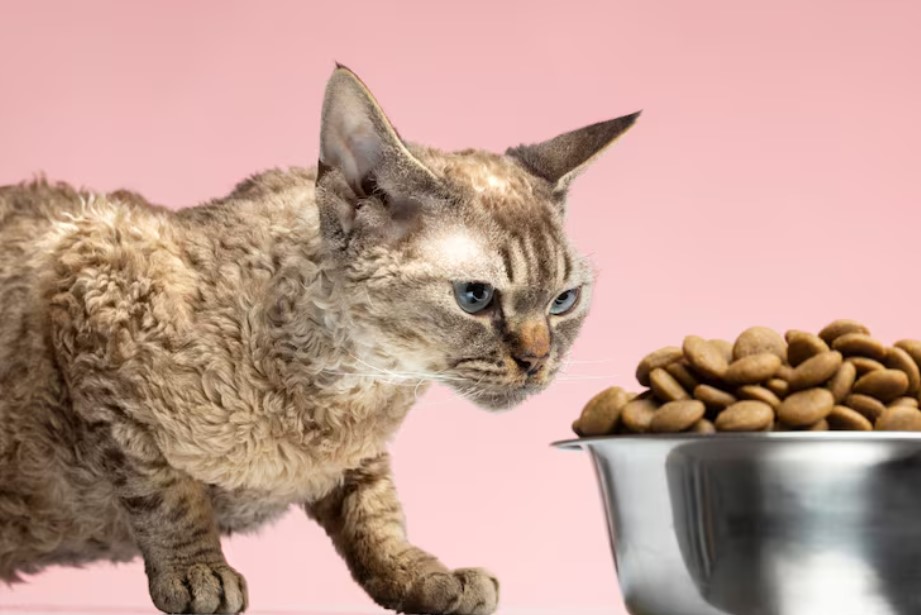
Dry cat food is convenient, affordable, easy to store, and simple to serve. However, leaving a full bowl available all day can make it difficult to control how much your cat eats. Kibble also contains much less water than wet food, so hydration needs extra attention.
That does not mean you must remove dry food from your cat’s diet. A healthy cat can often eat it safely when you control portions, provide several clean water sources, and watch for changes in weight, appetite, urination, and activity.
The goal is not simply to buy the most expensive bag. Responsible feeding depends on how much you serve, how often you serve it, and whether the formula matches your cat’s age, health, and activity level.
Why Dry Cat Food Requires Careful Portion Control
One of the main benefits of kibble is also one of its biggest risks. It is easy to pour.
A small amount may not look like much in the bowl, but dry diets can contain a high number of calories in a small volume. Adding a little extra at breakfast, giving treats during the day, and refilling the bowl before bedtime can quickly push a cat beyond its daily calorie needs.
Cornell University’s Feline Health Center identifies free feeding, where dry food remains available throughout the day, as an important factor in feline obesity. Cats may return to the bowl repeatedly, even when they are not truly hungry.
Indoor cats face a greater challenge because many do not burn as much energy as cats that roam, hunt, and explore outdoors. A quiet indoor cat may sleep for much of the day while eating the portion intended for a much more active animal.
Weight gain often happens slowly. You may not notice the first half-pound, especially on a fluffy cat. Over several months, however, those extra calories can affect movement, grooming, comfort, and general health.
Understand the Hydration Issue
Cats naturally obtain part of their water from food. This is why the moisture difference between wet and dry diets matters.
The U.S. Food and Drug Administration states that canned pet food is typically about 75% to 78% moisture, while dry food is commonly around 10% to 12% moisture.
A cat that eats mostly kibble must therefore drink more water separately. Some cats adjust well and visit the water bowl often. Others have a weak thirst drive or dislike the location, shape, smell, or cleanliness of their bowl.
This does not mean every kibble-fed cat will become dehydrated. It means owners should actively support water intake rather than assuming one bowl beside the food is enough.
Cats with urinary problems, kidney disease, diabetes, constipation, or other medical conditions may need a specific feeding and hydration plan. Their diets should be selected with a veterinarian instead of through trial and error.
Calculate How Much Dry Cat Food Your Cat Needs
The serving chart on the package is a starting point, not a fixed rule.
Feeding directions are based on general weight and life-stage ranges. AAFCO notes that these directions may need to be changed to meet an individual pet’s needs.
Your cat’s actual requirement can vary based on:
-
Current weight and ideal weight
-
Age and life stage
-
Indoor or outdoor lifestyle
-
Activity level
-
Spay or neuter status
-
Pregnancy or nursing
-
Medical conditions
-
Treats and other foods
-
The calorie density of the formula
Read the Calorie Statement
Look for “Calorie Content” on the package. It is usually shown as kilocalories per cup and kilocalories per kilogram.
Do not compare serving sizes without comparing calories. One formula may provide 320 calories per cup, while another may provide 450 calories per cup. Using the same scoop for both would give your cat very different amounts of energy.
Consider this simple example:
Your veterinarian recommends a hypothetical daily target of 220 calories. Your cat’s food contains 400 calories per cup.
The calculation would be:
220 ÷ 400 = 0.55 cup per day
That total must include any kibble used as treats or placed in puzzle feeders.
A veterinarian can help set a suitable calorie target, especially if your cat is already overweight. Do not place an obese cat on a severe calorie restriction without professional guidance. Cats need controlled, gradual weight loss.
Measure by Weight When Possible
A kitchen scale is usually more accurate than a cup or scoop.
Pet owners often serve rounded or overflowing cups without realizing it. Even a small daily measuring error can add a meaningful number of calories over a month.
Place the empty bowl on the scale, reset it to zero, and weigh the planned amount in grams. The package or manufacturer should be able to tell you how many grams equal one cup.
Pre-measuring the full daily allowance each morning also helps. Keep it in a separate container and serve only from that amount. When the container is empty, your cat has received the day’s food.
Replace Free Feeding With Scheduled Meals
Scheduled feeding makes calorie control easier and helps you notice appetite changes sooner.
Most healthy adult cats can have their daily portion divided into two or more meals. Some cats prefer several smaller servings because this pattern feels closer to their natural habit of eating small meals.
For example:
-
Breakfast: 30% of the daily amount
-
Midday puzzle feeder: 20%
-
Dinner: 30%
-
Evening feeding: 20%
An automatic feeder can help when nobody is home during the day. Choose one that releases measured portions rather than allowing constant access.
Scheduled meals also help multi-cat households. When one bowl stays out all day, it may be impossible to know which cat ate the food. One cat may gain weight while another receives too little.
Feed cats in separate rooms when needed. Pick up the bowls after the meal period so one cat cannot finish another cat’s portion.
Increase Water Intake in Practical Ways
Your cat should always have access to fresh, clean water. Still, simply placing a bowl on the floor may not be enough.
AAHA and AAFP guidance notes that diets with higher water content may improve total water intake. The guidance also recommends offering different water options so cats can express their preferences.
Try the following methods:
Place Water in Several Locations
Keep water bowls in quiet, easy-to-reach areas. A senior cat may need bowls on each floor because stairs can become uncomfortable.
Avoid placing every bowl directly beside the litter box. Many cats prefer separation between eating, drinking, and toileting areas.
Test Different Bowl Shapes
Some cats dislike narrow bowls that press against their whiskers. A wide, shallow ceramic, glass, or stainless-steel bowl may feel more comfortable.
Wash bowls daily. Saliva, food particles, dust, and hair can make the water less appealing.
Consider a Cat Water Fountain
Moving water attracts some cats. A fountain may encourage more frequent drinking, but it needs regular cleaning and filter replacement.
A fountain is not automatically better than a bowl. Offer both and observe what your cat prefers.
Add Moisture to Meals
You can add a small amount of water to dry cat food immediately before serving. Start with a teaspoon and see whether your cat accepts the new texture.
Do not leave moistened kibble sitting at room temperature for long periods. Discard leftovers and wash the bowl after the meal.
You may also combine measured kibble with a complete and balanced wet food, provided you calculate the calories from both. Cornell notes that wet food is commonly around 70% to 80% water and can be offered with or instead of dry food.
Choosing the Best Dry Cat Food for Your Cat
There is no single best dry cat food for every cat. The right choice depends on life stage, body condition, health history, preferences, and your veterinarian’s advice.
Begin with the nutritional adequacy statement. The FDA explains that a product labeled “complete and balanced” is intended to provide the nutrients required when used as the main diet. The statement should identify the appropriate life stage, such as growth, adult maintenance, or all life stages.
Look Beyond the Front of the Bag
Marketing phrases such as “premium,” “natural,” or “holistic” do not tell you whether a food is suitable for your individual cat.
When comparing dry cat food brands, check:
-
Nutritional adequacy statement
-
Intended life stage
-
Calories per cup
-
Feeding directions
-
Guaranteed analysis
-
Manufacturer contact information
-
Quality-control and nutrition expertise
-
Whether the company can provide detailed nutrient information
WSAVA recommends considering who formulates the diet, what quality-control steps the manufacturer uses, and whether the finished product is tested to confirm its nutrient content.
Do not choose a formula based only on the first ingredient. Ingredients work together as part of the complete recipe. The finished nutrient profile matters more than one attractive item on the ingredient list.
Compare Foods on a Dry-Matter Basis
Wet and dry foods cannot be fairly compared by reading the percentages on the package alone because their moisture levels are very different.
The FDA recommends converting nutrients to a dry-matter basis when comparing products with different moisture levels.
For everyday feeding, you may not need to perform this calculation yourself. Ask the manufacturer or your veterinarian for help when comparing protein, fat, fiber, or carbohydrate levels across different food formats.
Monitor Your Cat’s Weight and Body Shape
The number on the scale is only one part of the picture. Body condition shows how much fat your cat carries.
When your cat is standing, look down from above. You should usually see a gentle waist behind the ribs. From the side, the abdomen should rise slightly rather than hanging heavily.
Run your hands over the rib area. You should be able to feel the ribs under a light layer of fat without pressing hard. If the ribs are difficult to find, your cat may be carrying excess weight.
The WSAVA body condition scoring system uses a nine-point scale. A score of 5 out of 9 represents an ideal condition for many cats, although individual assessment is still important.
Weigh your cat every two to four weeks when changing portions. You can use a pet scale or weigh yourself while holding your cat, then subtract your own weight.
Record the result instead of relying on memory. A simple weight log can reveal a gradual upward or downward trend before the change becomes obvious.
Watch for Signs of Poor Hydration or Illness
Possible warning signs include:
-
Dry or sticky gums
-
Low energy
-
Reduced appetite
-
Constipation
-
Sunken-looking eyes
-
Changes in urination
-
Straining in the litter box
-
Vomiting or diarrhea
-
Sudden weight loss or gain
These signs do not always mean dehydration, and a home check cannot replace a veterinary examination.
Straining to urinate, making repeated litter box visits, crying in the box, or producing little to no urine requires urgent veterinary attention. Urinary blockage can become life-threatening, especially in male cats.
Also contact your veterinarian when your cat suddenly drinks much more than usual. Increased thirst may be linked to an underlying medical condition rather than a simple preference for more water.
Common Dry Feeding Mistakes
Refilling the Bowl Whenever It Looks Empty
An empty bowl does not always mean your cat needs more calories. Cats may beg because they enjoy attention, routine, or the taste of the food.
Ignoring Treat Calories
Treats, table food, dental snacks, toppers, and food used for training all count toward the daily intake. Use pieces from the measured kibble allowance when possible.
Using One Portion for Every Cat
Two cats of the same weight can have different calorie needs. Age, activity, muscle mass, and health can change how much each cat should eat.
Changing Food Too Quickly
A sudden switch may cause digestive upset or food refusal. Transition gradually over several days unless your veterinarian provides different instructions.
Assuming Grain-Free Means Weight-Friendly
A grain-free recipe can still be high in calories. Check the calorie statement instead of relying on front-label claims.
Buying Based Only on Price
Expensive food is not automatically the best dry cat food. At the same time, the lowest-cost option may not provide the manufacturer transparency or nutritional support you want. Evaluate the complete product, feeding cost, calorie density, and your cat’s response.
A Simple Daily Feeding Framework
Use this five-step routine:
-
Set the daily amount: Start with the package directions and confirm the target with your veterinarian.
-
Measure accurately: Use grams when possible.
-
Divide the portion: Serve two to four controlled meals.
-
Support hydration: Offer several clean bowls, a fountain, wet food, or water added at mealtime.
-
Review the results: Track weight, body condition, appetite, stool, urination, and activity.
For example, imagine an indoor cat named Luna. Her owner used to keep a full bowl available throughout the day. Luna slowly gained weight and rarely visited her water bowl.
Her owner began weighing the daily food, dividing it among three meals, and placing a water fountain in the living room. Part of the kibble was offered through a puzzle feeder, and one measured meal included wet food.
The plan did not require removing kibble. It changed how the food was served.
That is often the difference between convenience and responsible feeding.
Build a Safer Feeding Routine Today
Do not wait for visible weight gain or urinary problems before changing your routine.
Start by checking the calorie content of your current dry cat food. Measure one full day’s portion, divide it into scheduled meals, and place fresh water in at least two convenient locations.
Then weigh your cat and record the result. Review the routine with your veterinarian at the next visit, or sooner if your cat is overweight, drinks very little, has urinary symptoms, or lives with a chronic health condition.
The right food matters, but daily habits matter just as much. Measure each serving, encourage movement, support hydration, and choose a formula that fits your cat rather than following marketing claims alone.
Frequently Asked Questions
Can cats live on dry cat food only?
A healthy cat may be able to eat a complete and balanced dry diet as its main food, but water intake must be supported and monitored. Cats with kidney, urinary, digestive, metabolic, or dental conditions may need another type of diet.
Should I add water to my cat’s kibble?
You can add a small amount of clean water immediately before feeding if your cat accepts it. Start slowly, discard uneaten moistened food, and wash the bowl after each meal.
How often should an adult cat eat?
Many adult cats do well with two or more measured meals per day. Smaller, more frequent meals may work well for cats that eat too quickly or beg between meals.
How can I tell whether I am feeding too much?
Track your cat’s weight and body condition. If the waist disappears, the ribs become difficult to feel, or weight continues to rise, speak with your veterinarian about reducing calories safely.
How should I compare dry cat food brands?
Compare the nutritional adequacy statement, calories, life-stage suitability, manufacturer expertise, quality-control practices, and your cat’s individual needs. Do not make the decision based only on package claims or the first ingredient.